Portable Satellite Internet for Emergencies: A Decision Guide
Decide whether portable satellite internet fits an outage or evacuation plan by checking coverage, sky view, current service terms, power, setup, and lower-power alternatives.
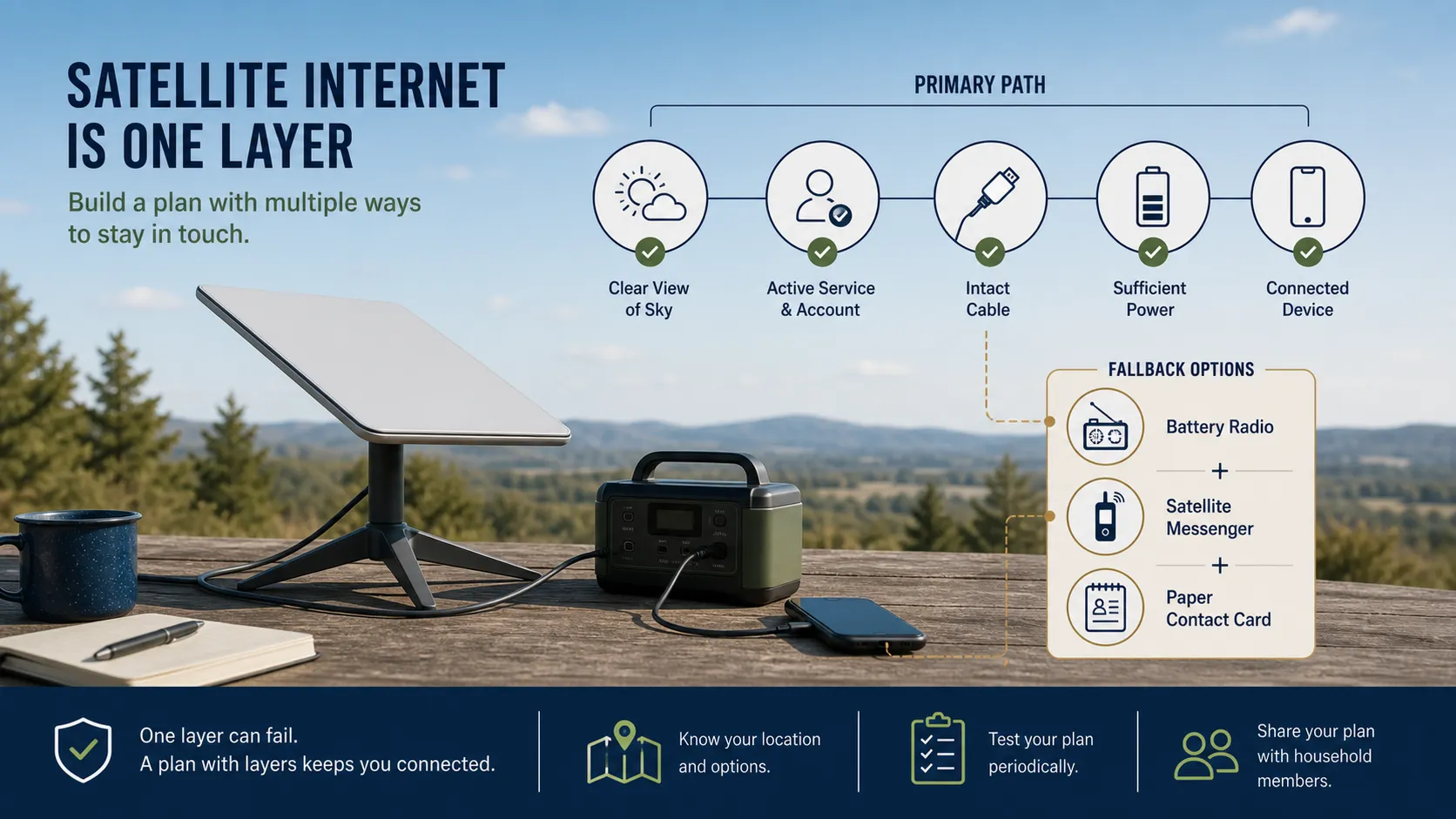
INFO
Treat satellite internet as one communication layer, not a rescue guarantee. Define the job, verify the current service plan and coverage, inspect the real operating location, calculate power for the complete setup, and practice the exact account and hardware before relying on it.
Portable satellite internet may provide maps, official updates, messages, or approved work access when local cable, fiber, or cellular paths are disrupted. It may also be unusable where the sky view, power, service status, weather, account, or placement rules do not fit.
This is a category decision, not a product ranking. Hardware, plans, roaming rules, availability, prices, and specifications change. Use current manufacturer documentation for the exact equipment and service you are considering.
Define the communication job first
Write the minimum successful outcome:
- Send a short status and location message
- Receive official weather and evacuation information
- Give several household devices limited data access
- Make an approved voice or video call
- Reach work systems for a short essential task
If the job is only a brief check-in, a satellite messenger or another lower-power path may be simpler than broadband equipment. If the job requires several devices or large data transfers, document the higher power, placement, and service dependencies before buying.
The complete emergency communication guide should define who sends the message, what it says, and what happens when satellite service is not available.
Compare the categories by constraints
Emergency communication categories
| Option | Often fits | Verify before relying on it |
|---|---|---|
| Portable satellite internet | A household needs a data connection for several devices and can support the equipment. | Current service, coverage, clear sky, power, mounting or placement, account access, and setup time. |
| Satellite messenger | The priority is concise status, location, or device-supported emergency messaging. | Coverage, subscription, message limits, emergency feature behavior, phone pairing, and battery care. |
| Cellular phone or hotspot | Cellular service remains available or returns intermittently. | Local coverage, battery, plan limits, congestion, and approved applications. |
| NOAA Weather Radio | The need is official weather and hazard information in a covered area. | Local transmitter, receiver compatibility, reception, batteries, and current outages. |
| FRS or GMRS radio | Nearby people need local coordination over a tested route. | Terrain, compatible equipment, batteries, privacy limits, and current FCC rules. |
Check the operating location
Inspect every likely use location: the home, apartment balcony, yard, vehicle stop, evacuation destination, or approved work site. A product’s coverage map does not prove that a particular spot has a usable view of the sky or allows equipment placement.
Confirm:
- The manufacturer’s required sky view and orientation
- A stable location outside standing water and traffic paths
- Safe cable routing that does not block an exit
- Building, rental, shelter, park, or homeowners association rules
- Wind, precipitation, temperature, and mounting limits in the exact manual
- Whether the operator can carry, place, and retrieve the equipment
- What happens if conditions make outdoor setup unsafe
Do not climb onto a roof or enter a hazardous area to preserve connectivity. Do not delay evacuation to pack, align, or troubleshoot the terminal.
Verify current service and account readiness
Before purchase and again before a high-risk season, read the provider’s current terms for the exact hardware and plan. For Starlink equipment, begin with the official Starlink support portal and the manual supplied for the specific terminal. For any other provider, use its equivalent first-party manual and service documents.
Record:
- The date the service terms and support information were checked
- Whether the service is available at the intended locations
- Activation, pause, resume, roaming, and cancellation rules
- Account credentials and approved recovery method
- Required phone application and software updates
- Data priority, limits, or traffic-management terms
- Support contact and the equipment identifier
- What features work when the paired phone has no cellular service
Do not rely on a reseller summary, old screenshot, or another model’s power specification. Keep account-recovery information available without exposing the password on a public emergency card.
Calculate power for the whole system
The terminal is not always the only load. Include the router if separate, power supply, any approved converter, the phone used for setup, and the client devices that must connect.
| Component | Label or measured watts | Hours planned | Required? |
|---|---|---|---|
| Satellite terminal | |||
| Router or gateway | |||
| Phone for setup and messages | |||
| Approved work or household device |
watts x hours = watt-hours
Use the manufacturer’s current normal and peak power information when it is published for the exact model, then compare it with an ordinary-day measurement. Signal conditions, software, temperature, connected devices, and operating mode can change consumption.
The Battery Runtime Calculator helps separate load, usable capacity, conversion loss, and reserve. It cannot confirm that a power bank, cable, inverter, or voltage adapter is compatible. Follow the exact manual and use only manufacturer-supported power paths.
The backup power for electronics guide helps protect phone and alert power before a broadband terminal consumes the reserve.
Plan the data budget and local network
Decide which devices may connect and which activities wait. During an outage, software updates, cloud photo sync, entertainment streaming, and background backups can compete with an essential message or work task.
- Use a strong unique network password
- Update the terminal and administration device before the season
- Turn off nonessential automatic transfers when appropriate
- Follow employer rules for VPN, customer data, and approved networks
- Keep the administration account protected with multifactor authentication when available
- Know how to disconnect an unknown device and reset access safely
CISA’s Secure Our World guidance emphasizes strong passwords, multifactor authentication, software updates, and phishing awareness. Use a known support site rather than an unexpected urgent account-renewal link during an outage.
Practice the complete setup
Do not make the first activation attempt during a warning or evacuation.
- Carry the packed equipment to the likely operating location.
- Set it up without improvising a mount, cable, or power adapter.
- Start from the stored account and recovery instructions.
- Connect the intended devices and complete one representative task.
- Measure the complete load and observe battery use.
- Shut down, cool, dry, inspect, and repack according to the manual.
- Write down the setup time, weak point, and fallback action.
Repeat after a plan, terminal, application, power system, or intended location changes. If only one person can operate the setup, train a second person or reduce the plan to a simpler layer.
Know when not to use it
Portable satellite internet is not the right response when:
- Local authorities instruct the household to move immediately
- The only operating location is unsafe or prohibited
- The equipment would consume power reserved for a more important need
- Current service cannot be confirmed
- The household needs only short status messages and a simpler path fits
- The user cannot safely carry or set up the complete system
- The communication plan has no fallback when it fails
Use the no-internet communication stack to keep paper, official alerts, local radio, and meeting-place instructions ready.
Portable satellite internet FAQ
Can portable satellite internet work during a power outage?
How much battery power does satellite internet need?
Is satellite internet better than a satellite messenger?
Does a portable satellite terminal replace emergency alerts?
Primary sources
- Ready.gov: Make a Plan
- FCC: Wireless Emergency Alerts
- NOAA/National Weather Service: NOAA Weather Radio
- CISA: Secure Our World
- Starlink: Official Support
Your next step
Carry the complete setup to its likely operating location and complete one real message or approved task on an ordinary day. Record power use, setup time, and the fallback action; if the location or reserve does not work, choose a simpler communication layer.
Keep this guide handy
Copy the page address to save it or send it to someone in your household.