Manufacturer research Specifications checked 2026-10-22 US model
Anker SOLIX C1000 Gen 2
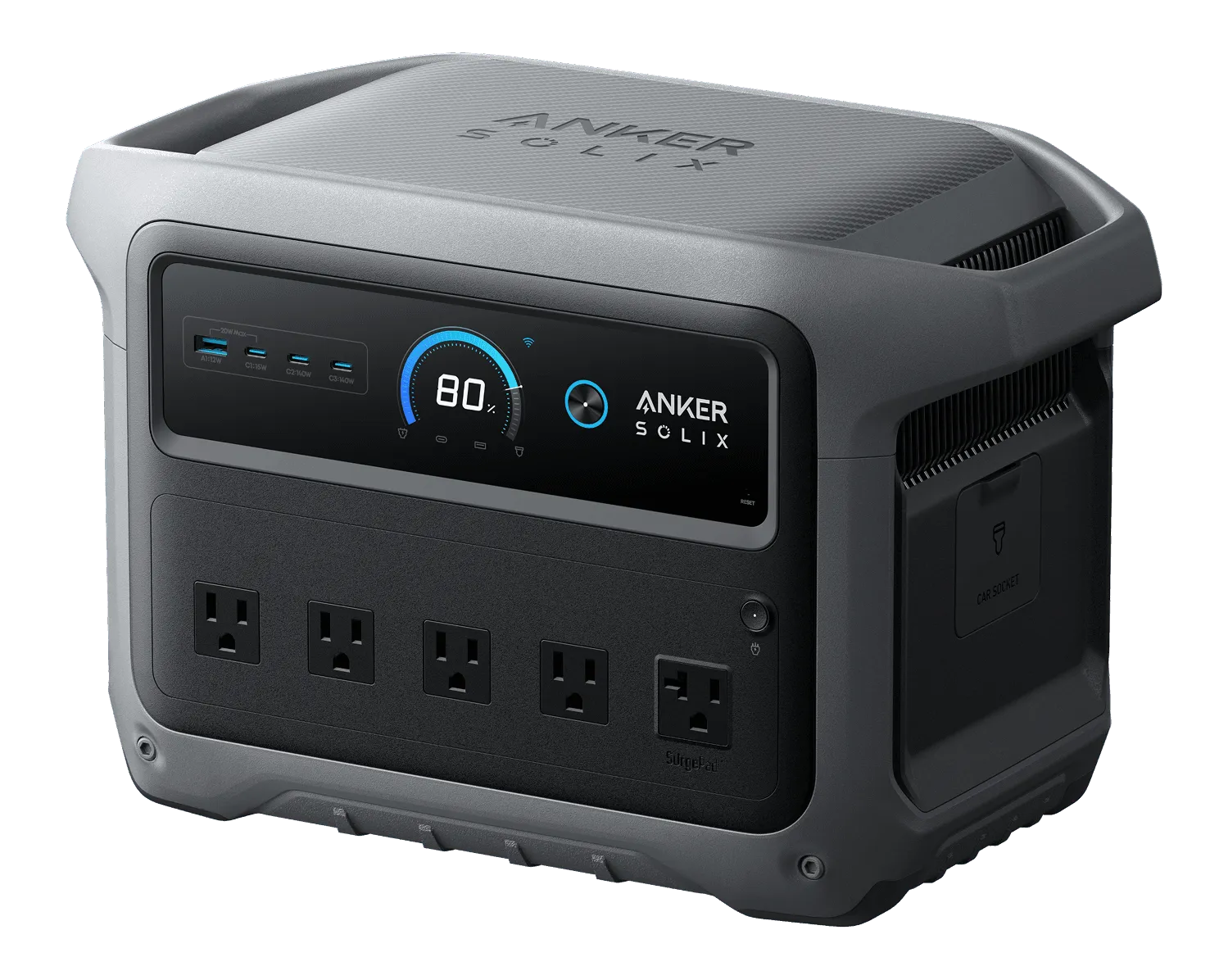
The SOLIX C1000 Gen 2 pairs 1,024 Wh of listed capacity with 2,000 W rated 120 V output and up to 600 W solar input. It is heavier and slightly lower-capacity than the Explorer 1000 v2, with a manufacturer-listed 10 ms UPS transfer figure and no expansion capacity in Anker's comparison table.
Paid links — we may earn a commission. As an Amazon Associate I earn from qualifying purchases.
 Check price at Amazon
- Nominal capacity
- 1,024 Wh Manufacturer source for Nominal capacity (checked 2026-10-22; opens in a new tab)
Is it right for your household?
Selected 120 V loads after checking running watts and startup demand.
240 V loads, over 2,000 W output, or battery-expansion needs.
More fit considerations
Other situations to consider
- Selected 120 V loads that benefit from the documented 2,000 W rated output after startup requirements are checked.
- Households prioritizing a higher solar-input ceiling and 10 ms UPS specification in this capacity class.
- Readers comparing base capacity, weight, footprint, output, and interruption tolerance side by side.
Other reasons to choose a different setup
- 240 V loads, needs above the 2,000 W rated AC output, or a plan that depends on additional battery capacity.
- Precision or strict-voltage equipment that is not supported by the manual's SurgePad feature.
- Households unable to handle a 24.9 lb station or support the charging and storage setup.
Manufacturer specification record · No hands-on testing · Source records checked between 2026-10-04 and 2026-10-22
Use the Gen 2 specifications, not the original C1000 figures
Anker lists C1000 Gen 2 at 1,024 Wh, 2,000 W maximum rated AC output, three AC output ports, 120 V, 600 W maximum solar input, 24.9 lb, and 15.12 × 8.19 × 9.61 in. Confirm the exact Gen 2 model and bundle before purchase; similarly named C1000 versions have different specifications.
Choose by the load and the recharge plan
The listed capacity is slightly below the Explorer 1000 v2's 1,070 Wh, while rated AC output and solar input are higher. Those specifications answer different questions: watt-hours concern stored energy, watts constrain the loads that can run together, and solar input is only a ceiling. Estimate daily energy and appliance starting demand, then confirm charging conditions and compatible panels. No specific runtime is promised.
Do not use SurgePad as a general surge rating
Anker's U.S. manual describes SurgePad for up to 2,400 W and says it works better with heat-generating devices. It does not support precision instruments or other devices with strict voltage requirements, and it is unavailable in bypass mode. This feature does not establish that a refrigerator, pump, compressor, or other motor will start. Check the appliance and follow both manufacturers' instructions; the product page's separate 3,000 W peak figure is not used here as an everyday or general motor-start rating.
Check the transfer requirement and expansion plan
The U.S. manual lists 10 ms UPS switching. Verify that every connected device can tolerate that interruption; a UPS label is not a guarantee for every motor, computer, or critical device. Anker's product comparison table lists no expandable capacity, so plan around the base station rather than assumed battery add-ons. Neither the 10 ms figure nor the capacity makes this a whole-home backup system.
Specifications & sources
These are manufacturer specifications, not independent performance measurements. Source records checked between 2026-10-04 and 2026-10-22. We have not tested this model hands-on.
- Nominal capacity
-
1,024 Wh
Checked 2026-10-22. Source for Nominal capacity (opens in a new tab)
- Battery chemistry
-
Not verified in this source record
Chemistry was not verified in the reviewed U.S. primary sources.
Checked 2026-10-04. Source for Battery chemistry (opens in a new tab)
- Continuous AC output
-
2,000 W
Rated maximum; check actual load and operating mode.
Checked 2026-10-22. Source for Continuous AC output (opens in a new tab)
- Surge output
-
Not verified in this source record
No general surge rating entered: manual describes SurgePad up to 2,400 W with limits; the product page separately markets 3,000 W peak.
Checked 2026-10-04. Source for Surge output (opens in a new tab)
- US AC outlet count
-
3 outlets
Three AC output ports shown in the official product overview.
Checked 2026-10-04. Source for US AC outlet count (opens in a new tab)
- 240 V AC output
-
No
U.S. AC output is listed at 120 V.
Checked 2026-10-22. Source for 240 V AC output (opens in a new tab)
- Maximum solar input
-
600 W
Checked 2026-10-22. Source for Maximum solar input (opens in a new tab)
- Maximum documented expanded capacity
-
Not verified in this source record
The manufacturer comparison table lists expandable capacity as No.
Checked 2026-10-04. Source for Maximum documented expanded capacity (opens in a new tab)
- Transfer / switching time
-
10 ms
UPS supports 10 ms switching.
Checked 2026-10-04. Source for Transfer / switching time (opens in a new tab)
- Base-unit weight
-
24.9 lb
Checked 2026-10-04. Source for Base-unit weight (opens in a new tab)
- Listed warranty term
-
Not verified in this source record
Warranty term was not verified in the reviewed U.S. primary sources.
Checked 2026-10-04. Source for Listed warranty term (opens in a new tab)