In this guideJump to a section
A sulfur-like smell at one sink can leave you wondering whether the issue is the drain, the water heater, the well, or the service line. A few careful observations help you describe what you notice, but they cannot identify the cause. The Minnesota Department of Health says hydrogen sulfide can arise naturally, from bacteria in a well or plumbing, or in a water heater; a rotten-egg odor is a clue, not a diagnosis.
The broader cloudy or discolored tap-water guide covers any sudden sensory change and how to check notices. This page narrows that task to comparing hot and cold water, fixture coverage, and public-system versus private-well next steps.
Compare ordinary taps without tasting the water
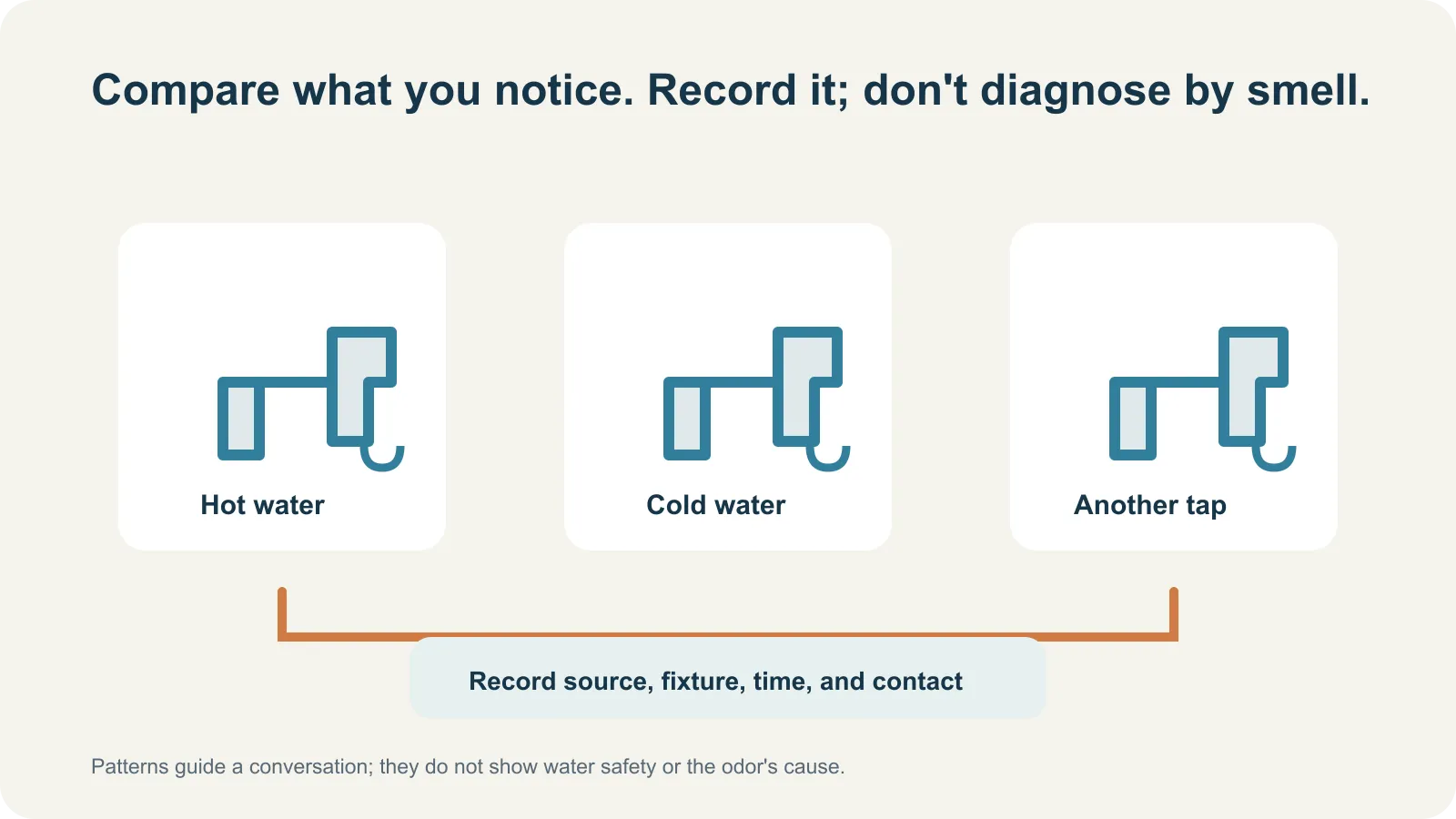
If there is an active advisory, follow it instead of testing taps. Otherwise, note what you smell during normal use; do not drink or taste water to check it, and do not create a large flow or enter a well pit or utility space. A quick hot/cold and fixture comparison can help a utility, plumber, or health department decide what question to ask next.
| Observation | What it may help the professional distinguish | Next contact |
|---|---|---|
| Hot water only | A water-heater context may be worth asking about; it does not prove the heater is the source | Plumber or heater manufacturer, especially before any service or anode change |
| Cold and hot water at several taps | A source or distribution/plumbing question may be broader than one fixture | Public-system provider; for a private well, local health department or well professional |
| One tap only | A localized fixture, drain, or branch may be relevant | Property manager or plumber; report other taps that do not have the odor |
| Several neighboring units or nearby homes report it | A shared building or service-area question may be involved | Building manager and public water provider |
| Private well, with a new odor or other water change | A new water-quality change needs local testing advice | Health department and state-certified laboratory |
These are routing clues, not a diagnostic tree. Minnesota’s health department suggests comparing hot and cold faucets and noting which taps have an odor, while also advising testing for well-water changes. Its page is written for Minnesota well owners; public-system customers should follow the provider that serves their address. CDC’s current well-testing guidance says to test a private well when taste, color, or smell changes and to ask the health department which tests fit local conditions.
Water-odor observation record
| Field | Record |
|---|---|
| Date/time | |
| Public system or private well | |
| Fixture and hot/cold pattern noticed during ordinary use | |
| Other affected taps or households if already known | |
| Current notice checked and time | |
| Utility/health department contact and advice |
A record might say “private well; bathroom hot and cold water; kitchen cold tap also affected; county notice checked; ask health department which lab tests apply.” The example does not diagnose a source.
Contact the water provider if multiple taps or neighbors are affected, and ask whether it has received similar reports or issued a notice. If you use a private well, CDC recommends a state-certified lab; ask the local health department which tests fit the odor and your area rather than ordering a generic “sulfur” test.
EPA lists rotten-egg odor as an aesthetic water-quality effect, but says odor-free water is not necessarily safe. Its secondary standards page cannot diagnose your sample. Do not enter a well pit, well house, or other enclosed space to investigate a possible sulfur-gas odor. Minnesota DOH warns that hydrogen sulfide can collect in low-lying or enclosed spaces and says only well professionals using proper precautions should enter them. Do not remove an anode, heat the water to disinfect it, or shock a well based on a smell—those interventions require exact system guidance and can introduce scalding, equipment, or confined-space hazards.