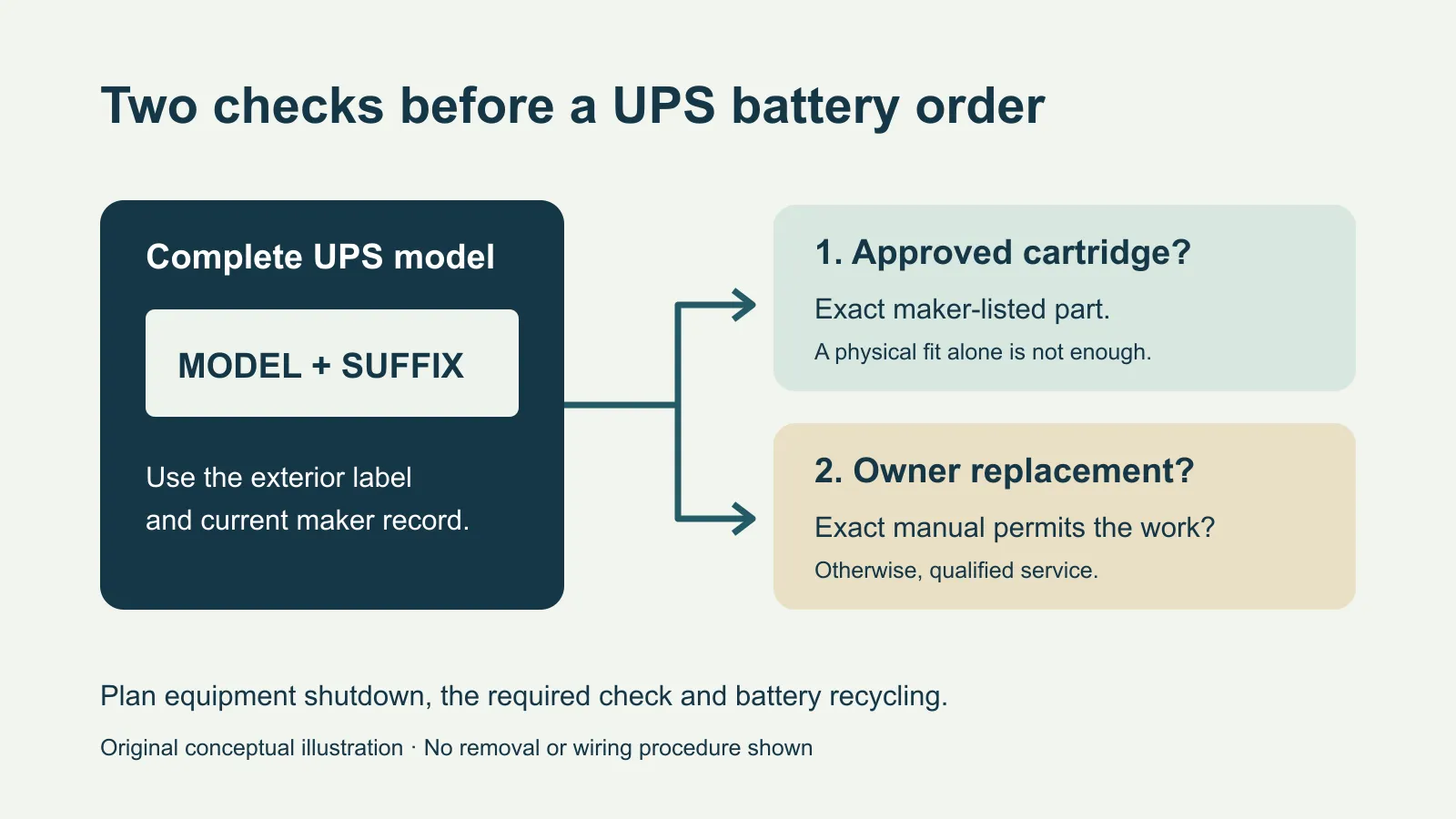
A battery warning does not tell you which replacement to buy. Start with the label on the UPS, not the battery dimensions in a shopping result. Two units that look alike can have different cartridges—or different rules about who may change them.
Check the complete model and service permission
Read an accessible exterior label or the purchase record without moving heavy equipment or removing covers. Keep every suffix. Then open the maker’s current support record and exact manual for that model and region.
Schneider Electric’s U.S./Canada replacement table illustrates the difference:
| Exact model in that table | Listed replacement and permission |
|---|---|
| APC Back-UPS BE425M | No replacement cartridge listed; battery is not user-replaceable. |
| APC Back-UPS BE600M1 | APCRBC154; listed as user-replaceable. |
| APC Back-UPS BE850G2 | RBC17; listed as user-replaceable. |
These are examples checked October 18, 2026, not a buying recommendation. Recheck the current entry before ordering. The same table warns that replacing batteries in units not designed for owner replacement can expose live electrical components and requires qualified service. An owner-service label still requires the exact procedure; it does not authorize opening the main enclosure or improvising a battery pack.
Use the warning and history together
Copy the exact warning from the display or supported software. Note installation date if known, changes to connected equipment, and whether the manufacturer-prescribed test reported a fault. “Unknown” is better than guessing a battery’s age.
APC’s VRLA battery guidance describes a typical three-to-five-year life influenced by environment and discharge history and recommends replacement before approximately five years. That is guidance for the maker’s lead-acid batteries, not a countdown for every chemistry. Do not wait for an age threshold when the unit reports a fault. Do not run repeated deep-discharge tests to try to clear a warning.
If the case is damaged, a battery is leaking or swollen, or there is unusual heat or odor, do not pry it out or attempt ordinary replacement. Keep clear and get the manufacturer’s handling instructions; use emergency services for smoke, fire or immediate danger. A replacement part cannot fix every UPS fault.
Plan the interruption before service
List what loses power if the UPS is taken out of service: the computer, NAS, router, switch or another device. Arrange the equipment’s normal shutdown before the work when required. Do not assume “user-replaceable” means it can be changed while the load remains powered.
Have the approved manual available for the entire job, including charging and post-replacement checks. If the procedure is not clear or access differs from its illustrations, use qualified service. A battery that fits and powers on has not yet demonstrated the required runtime or shutdown signaling.
Battery service record
| Item | Record |
|---|---|
| UPS identity | Complete model, region and manual/revision |
| Reported condition | Exact warning, date, age if known and recent load changes |
| Approved replacement | Maker’s part number and current source |
| Service permission | Owner procedure or qualified service; supporting manual page |
| Downtime | Devices affected and their shutdown arrangement |
| Return to use | Required charging and maker-approved check; result and date |
| Old battery | Chemistry, receiving facility and confirmed handling instructions |
EPA says rechargeable batteries belong with appropriate recyclers or collection programs, rather than household trash or municipal recycling bins. Identify the chemistry from its marking or maker documentation; shape is not enough. Confirm that a site accepts that battery type and condition before traveling, and follow its packaging directions. Damaged batteries may need a different route. A seemingly discharged battery can still retain hazardous energy.
After the manufacturer’s service and check, verify the equipment the UPS supports. For a NAS, the UPS shutdown checklist checks the signal and controlled-shutdown path that a battery replacement alone does not prove.